[ Content | Sidebar ]

Geotourism

March 20th, 2009

Geotourism and Destination Conservation 
Innovative Projects Honor Natural and Cultural Heritage at a Local Level


The National Geographic Center for Sustainable Destinations is teaming up with community leaders, non-profits, and other local stakeholders worldwide to help them promote their sense of place and prompt destination conservation.  The end product is a Geotourism MapGuide and or a website that is largely designed by local people.  It is unique because the people who know the places best get to share what makes their region special and ‘forms its essence’; residents identify the natural and cultural attractions that are featured.

The aim of these projects is to promote Geotourism, working directly with residents to preserve their unique cultural and natural heritage, build pride in their region and its communities, and inspire ongoing stewardship. Geotourism is defined as ‘tourism that sustains or enhances the geographical character of a place-its environment, heritage, aesthetics, culture and the well-being of its residents.’ Geotourism inherently incorporates the main tenet of sustainable tourism—protecting and preserving a destination’s character and environment. It also borrows the ecotourism concept that tourism revenue should promote conservation and contribute to the well-being of local residents. Geotourism, therefore, can be seen as an ‘umbrella concept’ that encompasses many tourism niches and approaches.

One example of a Geotourism project STI is helping to manage is in The Central Cascades of Oregon and Washington State. It involves working with residents throughout the region to create a MapGuide and interactive website to promote the area’s natural and cultural attractions, and foster a sense of pride in local communities. From an economic perspective, this project and others like it address the need to preserve environmental assets, help revitalize local economies—especially rural communities, and attract visitors who are seeking authentic experiences. To learn more about the Central Cascades Geotourism Project or to submit a nomination (through March 29, 2009), visit the website

Another related initiative, celebrating the distinct destinations of the world, is the “Geotourism Challenge 2009: Power of Place—Sustaining the Future of Destinations”. Join National Geographic and Ashoka’s Changemakers in the global search for innovative ideas in tourism that celebrate the distinct destinations of the world by honoring culture, cherishing history and enhancing the environment. Their collaborative competition was launched February 18, 2009 on Changemakers.net, and they are looking for savvy travelers and consumers to nominate places that exemplify the concept of Geotourism and real world practitioners working to sustain or enhance the geographical character of a place. Visit the Ashoka’s Changemakers website to read about the 2008 Geotourism Challenge winners, or to submit a nomination for this year’s Geotourism Challenge (entry deadline is May 20, 2009).

To see the geotourism map guide of Montana check out  http://www.crownofthecontinent.net.


Bill Hayden’s Blog on Glacier National Park

March 10th, 2009

NOTE: When I started writing this, this morning it was just snowing lightly. It looks like a full on winter storm outside right now, but I decided to post this anyway. Maybe this is just temporary…maybe!

You probably have noticed by now that the “Snowball Cam” has been replaced by a second Headquarters Cam. Snowball and friends have melted into the background for the remainder of the winter. They were fun while they were here and a HUGE hit with everyone that visited the site. I even had some great emails regarding the appropriate use of the name snowman vs snowpeople, etc… Many of them were just down-right funny and I wish I could share them here…but for many reasons, I can’t. Let’s just say that the anonymous nature of the Internet allows for tremendous freedom of speech. Thank you all for the comments, and thanks for your overwhelming support of our little friends outside the building. Now that it’s getting into March their habitat needs have changed enough to make their continued survival here precarious.

Speaking of habitat changes, people here have been hearing the haunting call of the Varied Thrush for the last couple of days. It’s one of the sure signs of Spring, although I imagine the thrushes are wondering if they didn’t get here a couple of days early, considering today’s weather outside. The song is a melodic whistle of varying pitches (hence the name) and very beautiful to hear. Do an Internet search for them and you can find a lot of sites about them, some of which have audio files of their calls. One that came up for me in my search was the Cornell Lab of Ornithology.

These robin sized birds spend the winter a bit further south in California and west of here in Washington and a bit of northern Idaho. In summer they migrate a bit further east to the Rockies of Montana and Idaho and up into Canada and Alaska.

I haven’t heard one yet, but I hope to soon. I always know when Spring is just around the corner when I can wake up to the Varied Thrush in the backyard, singing.

Latest news from Glacier National Park

March 5th, 2009


 No More Glaciers in Glacier National Park by 2020?

March 2, 2009

It's an oft-repeated statistic that the glaciers at Montana's Glacier National Park will disappear by the year 2030.

But Daniel Fagre, a U.S. Geological Survey ecologist who works at Glacier, says the park's namesakes will be gone about ten years ahead of schedule, endangering the region's plants and animals.

The 2030 date, he said, was based on a 2003 USGS study, along with 1992 temperature predictions by the UN's Intergovernmental Panel on Climate Change (IPCC).

"Temperature rise in our area was twice as great as what we put into the [1992] model," Fagre said. "What we've been saying now is 2020."

The 2020 estimate is based on aerial surveys and photography Fagre and his team have been conducting at Glacier since the early 1980s. A more standardized measure of what's happening to a glacier comes from arduous documentation of its mass, which requires—among other techniques—multiple core samples.

Fagre said the 2020 estimate could be slightly revised after his team conducts the mass measurements—hopefully this year—and their computer models are retooled with current temperatures.

Nonpolar ice is disappearing all over the globe, Fagre said. Major glaciers have entirely disappeared from the Andes, and the Himalaya have lost a third of their snow. (Seevideo of Alpine glaciers melting.)

Animals at Risk as Glaciers Melt

Fagre is concerned about ecological implications of glacier melt.

"A lot of our sensitive and rare plants are associated with the edges of glaciers," he said.

At first, retreating glaciers will expose more growing area for plants. But eventually plants will crowd the area, and reduced water could cause drying and die-offs.

And as glaciers retreat, the streams they feed can become intermittent, he added. 

"For some aquatic species, that's a threshold event," he said. "You only have to dry up once and you're history."


Not Cut-and-Dried

Andrew Fountain, a Portland State University professor of geography and geology, acknowledged that the glaciers of Glacier National Park shrank by 67 percent in the past hundred years.

"As a group, that is the fastest recession of any glaciated region in the lower 48 states" in the U.S., Fountain said.

But he's cautious about predicting the demise of any glacier.

In some situations, local topography can balance out climate change, he said.

"Take the Colorado Front Range, for example," he said.

"There is no reason for glaciers to inhabit Rocky Mountain National Park, climatically speaking. If it were not for … the drifting snow from the high plateau into the cirque basins"—valleys hollowed out by past glacial erosion—"you would not have glaciers there. But they are holding on fine."


Whitefish, MT, one of our gateway towns.

February 25th, 2009


All About Whitefish

Excerpted from “The Ultimate Montana Atlas & Travel Encyclopedia”

Whitefish is a recreational town located fifteen miles north of Kalispell and 23 miles from Glacier National Park. Located on the main east-west Amtrak line, it is situated on the south shore of the seven-mile-long Whitefish Lake and is only eight miles from The Big Mountain, a long established ski area. This town of about 5,000 people offers year-round recreational activities such as skiing, fishing, boating, hiking and backpacking, mountain biking, and golfing. Or for the really adventurous, get ready for an authentic cowboy evening: wagon rides, roping steer and spinning rope tricks. Then sit back to enjoy a hearty dinner Montana style while soaking up some cowboy lore.

The name “Whitefish” was given to this area by trappers in the mid 1850s when they discovered Indians catching native whitefish from the lake. The first permanent settler was John Morton who in 1883 built a cabin on the shore of Whitefish Lake just west of the river mouth. He was followed by loggers, Baker and the Hutchinson brothers, who logged around the lake in the early 1890s. But the actual town-site wasn’t surveyed and dedicated until 1903 when timber clearing and building earnestly began. Timber and farming, in addition to the budding railroad, formed the bulk of Whitefish economy for the next fifty years.

As the timber industry waned and the force of the railroad diminished, a large golf course and club house were built, which at the time was the largest in the state. Golf gave Whitefish an economic facelift and a few adventurous folks had begun skiing the Hellroaring Mountain north of Whitefish. In time a ski lift was built and today The Big Mountain Ski and Summer Resort extends a wide variety of year-round recreational opportunities, making it a recreational and retirement haven. Glacier National Park practically lies in the backyard of Whitefish. Whitefish has also gained international recognition as a special place to retreat or even raise a family and has been coined the holiday village of the Flathead Valley with lots of friendly people, good entertainment and great restaurants.

Mountaineer achieves rare winter solo of Glacier’s Mount Stimson

February 10th, 2009

Jason has worked for us as a guide on several occasions.

http://www.greatfallstribune.com/apps/pbcs.dll/article?AID=2009901290317

Mountaineer achieves rare winter solo of Glacier's Mount Stimson
BY MICHAEL BABCOCK • TRIBUNE OUTDOOR EDITOR • JANUARY 29, 2009
Read Comments(1) RecommendPrint this pageE-mail this articleShare

A Great Falls native who now lives in Whitefish has successfully climbed Mount Stimson in Glacier National Park.

Jason Robertson, a 30-year-old cabinetmaker, reached the summit of the 10,142 peak during a three-day expedition Jan. 20-22. He did it alone.

It was his ninth attempt. He has tried six other times during winter and twice during summer and each time had to turn back because of weather or gear problems.

"It was a great feeling after all those tries and putting up with bad weather and gear problems and anything you can think of that has gone wrong," Robertson said. "I have spent 60 days in the mountains in winter trying to climb that peak."

No Easy Thing

Jim Schroeder, president of the Glacier Mountaineering Society, said he is not aware of any other winter attempts on Mount Stimson.

"J. Gordon Edwards, in his "Climber's Guide to Glacier National Park," calls Stimson 'truly a monster of a mountain,'" Schroeder said. "The primary challenges presented by Stimson are the long, difficult approach, and 6,000 feet of vertical climb.

"Edwards noted that prior to 1978, there were very few people known to have summited Stimson. Now it is not unusual for several parties to reach the summit during any given summer," Schroeder said.

"I do know of some climbers who succeeded only after five or six attempts, so even in the summer, success on Stimson is not a given. I was fortunate to have made it on my first attempt."

To reach Mount Stimson, Robertson forded the Middle Fork of the Flathead River at Coal Creek Trailhead and then skied up Coal Creek Trail. Then he dropped down to ford Coal Creek for a 10-mile ski up Pinchot Creek.

From the headwaters of Pinchot Creek there is a 2,500 foot climb up to the saddle between Mount Stimson and Mount Pinchot.

"From there you gain the northeast ridge of Stimson," he said. "It was definitely steep in the upper thousand feet. I was using my ice tool, plunging my ice tool into the snow and using my ice axe. It is so steep that your knees are hitting the snow as you climb up."

A Three-Day Climb

Robertson climbed Stimson and returned in three days: He left Jan. 20, summited the next day and skied out on Jan. 22.

He said he encountered lots of wildlife along the way.

"Right away when I started, I ran into seven or eight huge elk," he said. "A golden eagle swooped right over my head and I saw tons of wolf tracks. I have pictures of my glove inside a wolf track. There were a couple of sets of cat tracks and I saw wolverine tracks near the saddle of Pinchot and Stimson."

That first night, Robertson camped at the base of the Stimson-Pinchot saddle. The temperature was about 2 degrees. He began climbing at 8:30 the next morning and he made it back to his camp in the saddle by 5:30 p.m.

During the climb, he said, the wind blew steadily at 25 to 35 miles per hour.

"Even with the thermometer in the sun and held close to my body, it never got above 20 degrees. But I have been in a lot worse winds. I have been in 50 mile-per-hour winds on ridge tops. I always think it is funny when you hear someone say they were in 100 mph winds. That would blow you away.

"Last year I got pretty high on Stimson and it started dumping snow — about two inches an hour. I didn't hesitate to turn around and get out and I made it from the base of the saddle to my car in four hours.

"This year, the ski out was in 10 degrees and the snow was perfect. I made it out in four hours and 15 minutes," he said.

One Of Six

Stimson is one of six 10,000-plus foot mountains in Glacier National Park.

"I would like to get up all the 10,000-foot peaks in the park in the winter. Stimson is the second highest," Robertson said.

Robertson has climbed St. Nicholas six times and Mount Duty twice.

"Two years I soloed St. Nick and Duty in 12 1/2 hours, which is pry the hardest thing I have ever done. I got up Kintla in December a couple of weeks before calendar winter two years ago."

Robertson said he knew summiting Stimson would be hard.

"I also heard Kintla was hard but Stimson was harder than Kintla, definitely. I have been on Siyeh numerous times in winter."

Robertson began climbing when he was 19. He says he loves winter climbing best.

"I love the beauty and knowing you are not going to see anyone else," he said. "I like it that no one is out there. It is all fresh tracks. A lot of the park has not been explored in the winter.

"Summer is easy and forgiving but in winter, nothing is easy and nothing is forgiven but the payoff is bigger."

"I also like the fact that I can control my body temperature in winter. My goal in winter is not to sweat. If I even think I am getting warm I shed a layer," he said.

Robertson said that when he reaches the peak of a climb, he is not necessarily full of jubilation. On Stimson, he says, he was really tired but focused.

"When I get to the top, I consider myself 40 percent there (to the end of the climb.) The descent is always more mentally challenging in my mind. I was just focused on getting down. I needed to hydrate and eat good and get a few good pictures and just focus on the down climb. It was kind of hard to enjoy when you have a huge down climb in front of you."

Next week he plans to ski up the Belly River and try for Mount Cleveland and Mount Merritt by taking Chief Mountain Road up and going in the Belly River.

Reach Babcock at 791-1487 or by email at triboutdoors@greatfallstribune.com.

Snow in Glacier

January 29th, 2009

I skied up by Polebridge (the northwest side of the park) and what a day, beautiful sun, about 4 inches of fresh snow and a good temperature - 25 degrees - pretty warm for this winter!!  Plenty of snow shoe hare tracks, some elk tracks and possibly some lynx tracks around the hare.  Other than this we are answering phones, making bookings and updating our web site.  On our "off" days, Denny, Randy and Judith have been working at Whitefish Mountain Ski Resort at our other job, Ski Patrol.  Getting excited about the spring, plenty of snow for the rivers and moisture for the huckleberries!  

Denny

Glacier Guides / Montana Raft - Rafting, Hiking, Backpacking and Chalets in Glacier National Park.

November 12th, 2008

November is here in full force.  We just finished an end of the season raft trip down the Missouri river.  The larches have lost their needles and now we are watching the snow level drop down the mountain sides.  Winter is close at hand.  Bring on the snow, the water bank for our summer adventures.  If you come out to visit this winter, stop by and visit with Cris, Randy, Judith or Denny.  We are here getting the office ready for next year.  Or give us a call/email and we can chat about your next adventure.  We have all of our dates set for the 2009 season. 

Denny

Fall With Glacier Guides and Montana Raft, 2008

October 31st, 2008

We have had a busy fall.  We sponsored Climate Ride 2008, with over 100 riders heading to Washington DC in support of renewable energy and reduced CO2 emissions.  We sent Denny to go along and be the main set it up, tear it down, and move the luggage guy.  Here at Glacier Guides Central we have finished putting everything away and last week we had our last trip, a great couple from New Jersey.  Now it is finishing the calendar for next year.  We have our dates for the Chalets and we will be done soon with all the dates.  Check out the web site for the latest or give us a call here in the office.  Judith, Randy, Denny or Cris would love to answer all questions.  Soon it will snow and after that we will be rafting and hiking again before you know it!! 

Rafting, Hiking, and Fishing report for Glacier Guides, Montana Raft. August 15th, 2008

August 14th, 2008

Current Conditions in Glacier National Park, August 15th , 2008 for Montana Raft and Glacier Guides

Good morning folks, this is Denny with your hiking and rafting report
for August 15th. The Glacier National Park forecast for this weekend is:

West Glacier
Saturday: Sunny, with a high near 92. Calm wind.
Saturday Night: Partly cloudy, with a low around 48.
Sunday: A 20 percent chance of showers and thunderstorms after noon. Partly cloudy, with a high near 93.
Sunday Night: A slight chance of showers and thunderstorms. Partly cloudy, with a low around 51.

St. Marys
Saturday: Sunny, with a high near 83. West wind around 8 mph.
Saturday Night: Partly cloudy, with a low around 49.
Sunday: A 20 percent chance of showers and thunderstorms after noon. Partly cloudy, with a high near 83.
Sunday Night: A slight chance of showers and thunderstorms. Partly cloudy, with a low around 47.

The river level is 2.32 feet (1190 cfs) in West Glacier, creating a
family fun wet adventure. We have been running Paola down to
Blankenship on the Middle Fork and Ford Ranger Station down on the
North Fork. We are running inflatable kayaks. Bonecrusher and Big
Squeeze have great waves at this level, but be aware of Can Opener in
Tunnel, Bonecrusher, and rocks above and in Screaming Right Hand Turn.

Remember we only put a maximum of 8-9 people per boat so everyone can have a window seat!

We have been fishing on the North Fork and Middle Fork with great
results. Catching mostly rainbows, cutthroats and cut bows. 12 feet
clarity with the water dropping and clearing daily. Terrestrials and
foam bugs, foam lines are fishing well, try some hoppers, early morning
and later in the day are fishing well, try a stimulator mid day.
Oxygenated water is fishing well.

The Going to the Sun Road is open. Expect snow on the hiking trails at Logan Pass.

The trails are in great shape, but watch for slippery creek crossings,
especially around waterfalls. Expect patchy snow above 7000 feet, on
southern exposures at a higher elevation. Ice axes and crampons are
recommended for Gunsight Pass, Como Pass and heading over Boulder Pass.
Please contact the park for more details at 406 888 7800.

Closed Trails and Areas
Hidden Lake Outlet area, for resource protection.

Mt. Henkel and Mt. Altyn for resource protection.

Oberlin meadows/Renolds is closed due to emerging vegetation. There is a map at the visitor center for access to Oberlin peak.

Posted Trails and Areas
Swiftcurrent Valley Trail, trailhead to Bullhead Lake. Bears.

Iceberg/Ptarmigan Trail, trailhead to junction above Ptarmigan Falls. Bears.

Swiftcurrent Pass Trail, Trailhead to Red Rock Falls. Mountain Lions.

Trail Reports
Lake McDonald Valley

Hidden Lake Trail – Snow cover: 3%. HAZARDOUS SNOW ADVISORY: Snow
bridges exist and are dangerous; please follow the yellow trail markers
installed from the Visitor Center to the overlook. Use caution along
wet rocks and melting creek areas.

Highline to Granite Park Chalet - Snow cover is about 5%.
SNOW HAZARD ADVISORY: Hiking poles may be helpful for some hikers in crossing small patches of snow.

Sperry Glacier Trail from the Chalet has SNOW HAZARD, WATER HAZARD
ADVISORY. Trail is clear for the first 1.5 miles. The next 2.2 miles to
the headwall are 30% snow covered and the trail is crossed by a few
steep snowfields; hidden snow bridges exist and caution is advised. The
headwall steps can be accessed without too much problem, the trail
going up to it has little snow cover, although it is very wet
(snow-free also in the staircase itself). Once past the stairwell,
trail is 60% snow covered but it is easy to follow the footsteps and
carins to Sperry Glacier. Overall, hiking poles or an ice axe strongly
recommended, as well as expirience using them and/or expirience on snow
and ice.

Avalanche Lake Trail is clear. *PLEASE be mindful of "Restoration Area"
signs along the trail and around the campground and try to
prevent/reduce resource impacts by staying on the trail or walking on
durable surfaces (ex: lakeshore, rocks, logs, etc.).*

Loop Trail is clear of snow.

Apgar Lookout free of snow, some trees down.

Mt Brown Lookout is free of snow.

St. Marys Valley
Siyeh Pass does have some snow on the baring creek side.

Gunsight Pass has four snow fields remaining 1/2 mile before Gunsight
Pass, two are a little tougher to get around. Ice axe, crampons, and
the ability to self-arrest recommended. One snowfield is about 25
meters wide at the point of crossing with a steep run out of 200 meters
ending in rocks. The other snowfield is at a moderate angle with a
short run out into a scree field. Steps are kicked out through one of
the fields and snow was hard and icy late in the day. It was possible
to skirt around all but the one snowfield with the steps kicked out,
which was relatively easy to cross IF you have experience on snow and
ice. The last 200 yards of trail leading to the pass is partly
snow-covered, with the pass itself free of snow. Snow can be avoided by
skirting above and below slopes on steep rocks. The snow patches flaten
out and taper off at the pass but avoid the edges drops off at a near
80 degree angle with a long snow run out ending in cliffs.

Many Glacier Valley
Iceberg Lake Trail is open but is posted for Bears frequenting. There are icebergs.

Grinnell Glacier Trail has snow cover at 1%, just a couple of small
snow patches. Some glacial ice showing on Grinnell Glacier. Upper
Grinnell lake mostly frozen.

Ptarmigan Falls to Ptarmigan Tunnel. The tunnel is open.

Two Medicine Valley
Dawson Pitamakin is reporting a little snow, but no snow hazard.

North Fork
Head of Bowman Lake towards Browns Pass has a couple of trees down and a stream crossing at Pocket Creek.

Kintla Lake to Boulder Pass is clear of trees, 5% snow cover at 7000 feet below Boulder Pass Campground.

Backpacking
Mcdonald Lake CG is closed and expected to stay that way until reconstructed.

Round Prairie is in spring conditions and may open in the next couple weeks.

Fifty Mountain, Boulder, Isabel, Camas Lake and Cobalt Lake have recently opened.

Backpackers are now going over Red Gap Pass, Gunsight, Boulder, Stoney
Indian, Dawson, Pitamakin, Triple Divide, Swift Current and Browns Pass.

The bears and lions are out and about. Use caution around wildlife,
there are young of the year and their parents are very protective.
Remember, we sell bear spray at cost.

Before a long day of adventuring in Glacier please stop by the
Bonecrusher Bistro for an espresso, breakfast burrito or sandwich (open
8 am to 6 pm). Or stop by after for a smoothie, home made cookie or ice
cream cone.

Hiking, Fishing and Rafting Report for Glacier Guides and Montana Raft for Glacier National Park

August 7th, 2008

Current Conditions in Glacier National Park, August 8th , 2008 for Montana Raft and Glacier Guides

Good morning folks, this is Denny with your hiking and rafting report for August 8th.  The Glacier National Park forecast for this weekend is:

West Glacier
Saturday: A 30 percent chance of showers and thunderstorms. Partly sunny, with a high near 82. South southwest wind between 8 and 13 mph.
Saturday Night: A 20 percent chance of showers and thunderstorms. Mostly cloudy, with a low around 50.
Sunday: A slight chance of showers, with thunderstorms also possible after noon. Partly sunny, with a high near 74. Chance of precipitation is 20%.
Sunday Night: A slight chance of showers and thunderstorms. Mostly cloudy, with a low around 42.

St. Marys
Saturday: A 30 percent chance of showers and thunderstorms, mainly after noon. Partly sunny, with a high near 76. Southwest wind between 5 and 10 mph.
Saturday Night: A chance of rain and thunderstorms before midnight, then a chance of showers and thunderstorms after midnight. Mostly cloudy, with a low around 60. Chance of precipitation is 30%.
Sunday: A slight chance of rain and thunderstorms before noon, then a slight chance of showers and thunderstorms after noon. Partly cloudy, with a high near 72. Chance of precipitation is 20%.
Sunday Night: A slight chance of showers and thunderstorms. Mostly cloudy, with a low around 42.

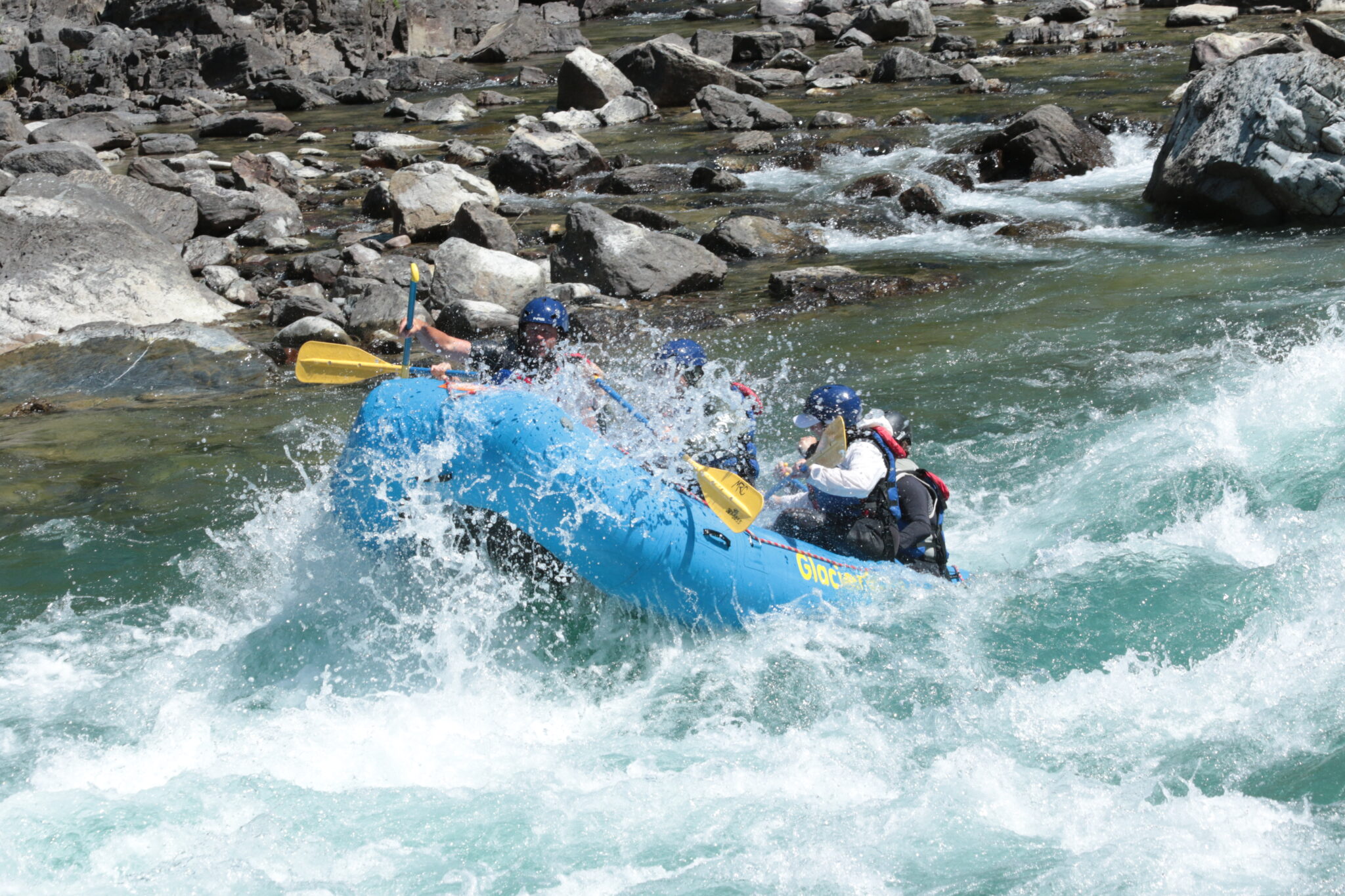
The river level is 2.53 feet (1510 cfs) in West Glacier, creating an awesome wet adventure.  We have been running Paola down to Blankenship on the Middle Fork and Ford Ranger Station down on the North Fork.  We are running our Thrill Seekers and inflatable kayaks.  Remember we only put a maximum of 8-9 people per boat so everyone can have a window seat!  Bonecrusher and Big Squeeze have great waves at this level, but be aware of Can Opener in Tunnel, Bonecrusher, and rocks above and in Screaming Right Hand Turn.

We have been fishing on the North Fork and Middle Fork with great results.  Catching mostly rainbows, cutthroats and cut bows.  12 feet clarity with the water dropping and clearing daily.  Terrestrials and foam bugs, foam lines are fishing well, try some hoppers, early morning and later in the day are fishing well, try a stimulator mid day.   Look for Rainbows in more oxygenated water.   

The Going to the Sun Road is open.  Expect snow on the hiking trails at Logan Pass.

The trails are in great shape, but watch for slippery creek crossings, especially around waterfalls.  Expect snow above 7000 feet, on southern exposures at a higher elevation.  Ice axes and crampons are recommended for Gunsight Pass, Como Pass and heading over Boulder Pass.  Please contact the park for more details at 406 888 7800.

Closed Trails and Areas
Hidden Lake Outlet area, for resource protection.

Mt. Henkel and Mt. Altyn for resource protection.

Oberlin meadows/Renolds is closed due to emerging vegetation.  There is a map at the visitor center for access to Oberlin peak.

Posted Trails and Areas
Swiftcurrent Valley Trail, trailhead to Bullhead Lake.  Bears.

Grinnell Glacier Trail from the head of Josephine to the Glacier.  Bears.

Iceberg/Ptarmigan Trail, trailhead to junction above Ptarmigan Falls.  Bears.

Swiftcurrent Pass Trail, Trailhead to Red Rock Falls.  Mountain Lions.

Trail Reports
Lake McDonald Valley

Hidden Lake Trail – Snow cover: 7% coverage with intermittent areas of exposed boardwalk.
HAZARDOUS SNOW ADVISORY: Snow bridges exist and are dangerous; please follow the yellow trail markers installed from the Visitor Center to the overlook. Use caution along wet rocks and melting creek areas.

Highline to Granite Park Chalet - Snow cover is about 5%.
SNOW HAZARD ADVISORY: Hiking poles may be helpful for some hikers in crossing small patches of snow.

Sperry Glacier Trail from the Chalet has SNOW HAZARD, WATER HAZARD ADVISORY. Trail is clear for the first 1.5 miles. The next 2.2 miles to the glacier are 50% snow covered and the trail is crossed by several steep snowfields; hidden snow bridges may exist. The headwall steps can be accessed without too much problem (snow-free in the staircase itself). Overall, hiking poles or an ice axe strongly recommended.

Avalanche Lake Trail is clear. *PLEASE be mindful of "Restoration Area" signs along the trail and around the campground and try to prevent/reduce resource impacts by staying on the trail or walking on durable surfaces (ex: lakeshore, rocks, logs, etc.).*

Loop Trail is clear of snow.

Apgar Lookout free of snow, some trees down.

Mt Brown Lookout is free of snow.

St. Marys Valley
Siyeh Pass does have some snow on the baring creek side.

Gunsight Pass has two prominent snow fields remaining 1/2 mile before Gunsight Pass. Ice axe, crampons, and the ability to self-arrest recommended. One snowfield is about 30 meters wide at the point of crossing with a steep runout of 200 meters ending in rocks. The other snowfield is at a moderate angle with a short runout into a scree field. Steps are kicked out through both fields and snow was hard and icy late in the day. The last 200 yards of trail leading to the Pass is completely snow-covered, snow can be avoided by skirting above and below slopes on steep rocks. The snow field flatens out at the pass but avoid the edge of this field as it drops off at a near 80 degree angle with a long snow runout ending in cliffs.

Many Glacier Valley

Iceberg Lake Trail is open but is posted for Bears frequenting.  There are tons of icebergs.

Grinnell Glacier Trail is 70% covered with snow above Thunderbird Falls.

Ptarmigan Falls to Ptarmigan Tunnel.  The tunnel is open.

Two Medicine Valley
Dawson Pitamakin is reporting a little snow, but no snow hazard.

North Fork
Head of Bowman Lake towards Browns Pass has a couple of trees down and a stream crossing at Pocket Creek.

Kintla Lake to Boulder Pass is clear of trees, 5% snow cover at 7000 feet below Boulder Pass Campground.

Backpacking
Mcdonald Lake CG is closed and expected to stay that way until reconstructed.

Isabel, Camas Lake and Round Prairie are in spring conditions and are expected to open in the next couple weeks.

Fifty Mountain, Boulder and Cobalt Lake have recently opened.

Backpackers are now going over Red Gap Pass, Gunsight, Boulder, Stoney Indian, Dawson, Pitamakin, Triple Divide, Swift Current and Browns Pass.

The bears and lions are out and about.  Use caution around wildlife, there are young of the year and their parents are very protective.  Remember, we sell bear spray at cost. 

Before a long day of adventuring in Glacier please stop by the Bonecrusher Bistro for an espresso, breakfast burrito or sandwich (open 8 am to 6 pm).  Or stop by after for a smoothie, home made cookie or ice cream cone.